
The Olinia project, driven by the progressive government of Mexico, represents Mexico’s first systematic attempt to transform itself from an assembler of foreign brands into a manufacturer with its own automotive brand.
Today, Mexico is one of the top 5 car-assembling countries in the world — but the only one without a domestic automotive brand, alongside China, the United States, Japan, and India. Olinia seeks to close that gap as an exercise in technological sovereignty.
Developed by a team of over 80 academics, technicians, and researchers coordinated by Roberto Capuano Tripp, Olinia is the result of a collaborative effort between the Tecnológico Nacional de México (TecNM) and the Secretariat of Science, Humanities, Technology and Innovation (Secihti).
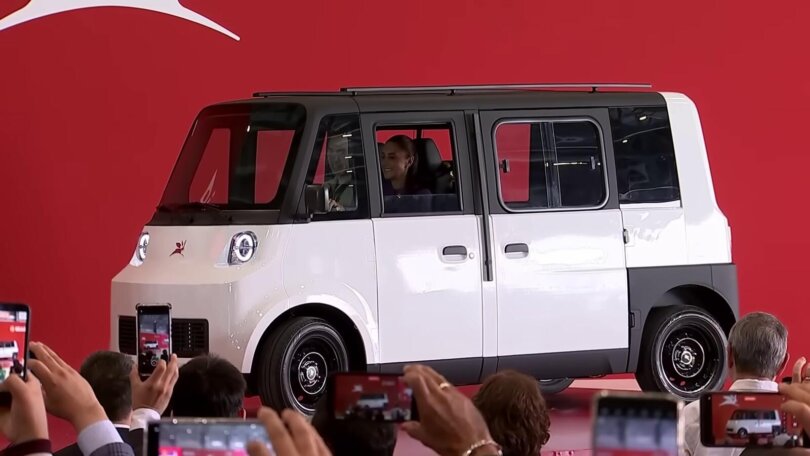
They told us we couldn’t, that we shouldn’t. They told us innovation was reserved for other places, that Mexico was only meant to assemble what others designed. But that is false.— Claudia Sheinbaum, President of Mexico, at the Olinia presentation
The name comes from Nahuatl and means “to move” — a choice that encapsulates the project’s philosophy: driving sustainable mobility from Mexico’s cultural identity.
Official Technical Specifications
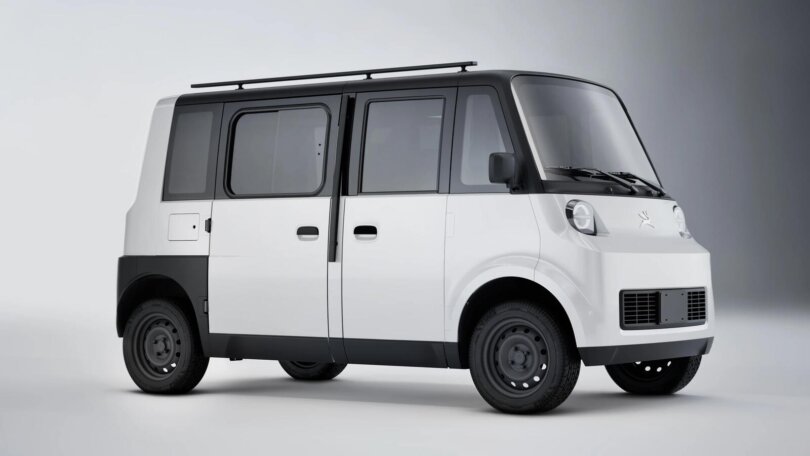
The Olinia Uno prototype in side view reveals the rear suicide doors designed to facilitate entry and exit on narrow streets and compact parking spaces.
According to the project’s official website, olinia.auto, the confirmed features of the base model are:
| Specification | Confirmed Value |
|---|---|
| Capacity | 6 seats with seat belts |
| Propulsion | 100% electric |
| Motor | 13.5 kW |
| Battery | 14.7 kWh |
| Range | +100 km |
| Top speed | 50 km/h (limited by design for urban safety) |
| Charging | Any conventional household outlet (NACS connector) |
| Protection | IP67 on motor and battery (water and flood resistance) |
| Operating cost | ~$0.49 MXN/km (~$0.03 USD/km) |
| Domestic content | ~50% current (75% target by 2030) |
| Base price | From $150,000 MXN (~$8,717.28 USD) |
| Production start | Summer 2027 |
Comparative Analysis: Strategic Positioning
Olinia does not compete with high-end electric vehicles or conventional highway cars.
To put it in perspective, in China, Wuling — one of the most popular mass-market brands — sells millions of units of its Hongguang Mini EV, proving that the mini-car segment is not marginal: it is the urban mobility of the future in developing economies.
Its market strategy targets short-range urban transportation, a segment currently dominated by mototaxis and sedan taxis.
| Parameter | Sedan Taxi | Olinia Uno | Moto Taxi |
|---|---|---|---|
| Cost per km | ~$2.40 MXN (~$0.14 USD) | ~$0.50 MXN (~$0.03 USD) | ~$1.18 MXN (~$0.07 USD) |
| Capacity | 4 passengers (seat belt) | 6 passengers (seat belt) | 1-2 passengers (no seat belt) |
| Cabin | 100% enclosed | 100% enclosed | Exposed, no protection |
| Weather protection | Full | Full | None |
| Emissions | Moderate, polluting | Zero, 100% electric | High, very polluting |
| Comfort | High | High | Low |
Projected Operational Savings
The official website includes a calculator that projects monthly expenses based on daily kilometers driven:
| Usage Profile | Km/day | Monthly savings vs. sedan taxi |
|---|---|---|
| Personal use | 20 km | $408 – $1,140 MXN |
| Urban operator | 60 km | $1,224 – $3,420 MXN |
| Intensive route | 120 km | $2,448 – $6,840 MXN |
At 75 km/day, savings vs. a gasoline car exceed $50,000 MXN (~$2,905.8 USD) per year in fuel alone.
Design and Product Architecture
The revealed prototype includes features that surprised the market:
- Universal accessibility: First vehicle in its category with space and an anchor system for a wheelchair, allowing the companion to ride in front.
- “Suicide” rear doors: Open in the opposite direction for easy access in tight spaces — an engineering solution designed for narrow streets and compact parking.
- LED teardrop-shaped headlights and chrome front emblem
- Floating black roof with roof rails
- Official colors: Yellow, white, and orange with black accents
- Interior capacity: Up to 6 passengers in a compact urban format
Model Portfolio: Three Modular Configurations
The project features a shared platform with three variants aimed at different use cases:
1. Personal Mobility
Compact vehicle for everyday trips (work, school, urban commutes). Aimed at users looking for a safer, more affordable alternative to a motorcycle.
2. Neighborhood Mobility
Electric mototaxi-style configuration for passenger transport within neighborhoods and urban communities. Seeks to formalize and electrify a segment currently dominated by combustion-powered tuk-tuks.
3. Last Mile Deliveries
Logistics variant for delivery drivers, small businesses, and courier companies. The Olinia Cargo was presented as the specific variant for this market.
Engineering Analysis: Why 50 km/h and +100 km Range?
From a technical standpoint, the Olinia Uno’s specifications are not technological constraints:
They are conscious design choices that define its product architecture.
For reference, the Hongguang Mini EV — the best-selling mini-vehicle in the world — travels at 100 km/h; Olinia takes the same logic to the urban extreme.
Speed Limited to 50 km/h
- L6e/L7e classification: Olinia is classified as a heavy quadricycle, a category that in Europe does not require a type B driver’s license (only AM or B1). This reduces regulatory and access barriers.
- Simplified passive safety: At 50 km/h, requirements for crumple zones, airbags, and restraint systems are less demanding than at 120 km/h, reducing cost and weight.
- Energy efficiency: The electric motor’s power is sized for low consumption rather than high performance.
+100 km Range
- 70% of daily commutes in Mexico are under 30 km. 100 km of range covers 3 days of average use without recharging.
- Home charging: No need for fast-charging (DC) infrastructure. A standard 120V/15A household outlet can recharge the battery in 6-8 hours overnight.
- Battery: 14.7 kWh, located between the rear wheels under the floor. At ~$110 USD/kWh, it represents a significant portion of the vehicle’s cost.
6 Seats in a Compact Format
- 2+2+2 or 3+3 configuration with slim seats and reduced spacing, taking advantage of the absence of a transmission tunnel inherent to EVs.
- Comparison: a Tata Punch EV (similar segment) seats 5. Olinia gains one seat by sacrificing trunk space — a bet geared toward mototaxi/neighborhood use.
Production Infrastructure
| Component | Confirmed Location |
|---|---|
| Battery factory | Puebla |
| Final assembly | Puebla (under definition) |
| Development center | Tecnológico Nacional de México, Puebla |
The choice of Puebla leverages the concentration of technical talent from TecNM and the existing industrial infrastructure in the region.
The charging infrastructure plan includes 2,000 charging points in an initial phase in Mexico City, State of Mexico, and Puebla, in collaboration with SENER and CFE, with a target of tens of thousands by 2030.
Technical and Regulatory Challenges
The project faces two structural challenges. The first is regulatory: Mexico lacks a legal framework for mini-vehicles, and the proposed regulation presented in 2025 is still under discussion — without it, Olinia cannot be driven on public roads. The second is investment: the announced 25 million pesos (~$1.2M USD) is far from the ~$1,000M USD that developing a new vehicle typically costs. The post-sales service network, nonexistent at launch, is an immediate challenge that will determine whether the promise of low maintenance is fulfilled.
Conclusion: Frugal Engineering, Not Luxury
Olinia Uno does not aspire to be a Mexican BYD. It is, in essence, a redefinition of the urban mobility problem from the perspective of domestic engineering: How do you efficiently transport millions of people in cities with narrow streets, congested traffic, and limited budgets?
The answer is a compact vehicle with 50 km/h top speed, 100 km range, 6 seats, rechargeable from any wall outlet, with an operating cost of ~$0.50/km (~$0.03 USD/km) — lower than even a combustion motorcycle.
If the project reaches mass production, we will not only have witnessed the birth of Mexico’s first automotive brand, but also the materialization of an engineering bet on the democratization of electromobility in Latin America.
What Do You Think? Do you think Olinia can establish itself as a real alternative in the Mexican market, or will regulatory and industrial challenges limit it to a niche project? Is a vehicle with a 50 km/h top speed viable in the Mexican urban context? Leave us your comment from an engineering perspective.
Sources: Official website olinia.auto, statements by Roberto Capuano Tripp, Secretariat of Science, Humanities, Technology and Innovation (Secihti). Exchange rate: 1 USD = 17.2072 MXN (June 16, 2026).


